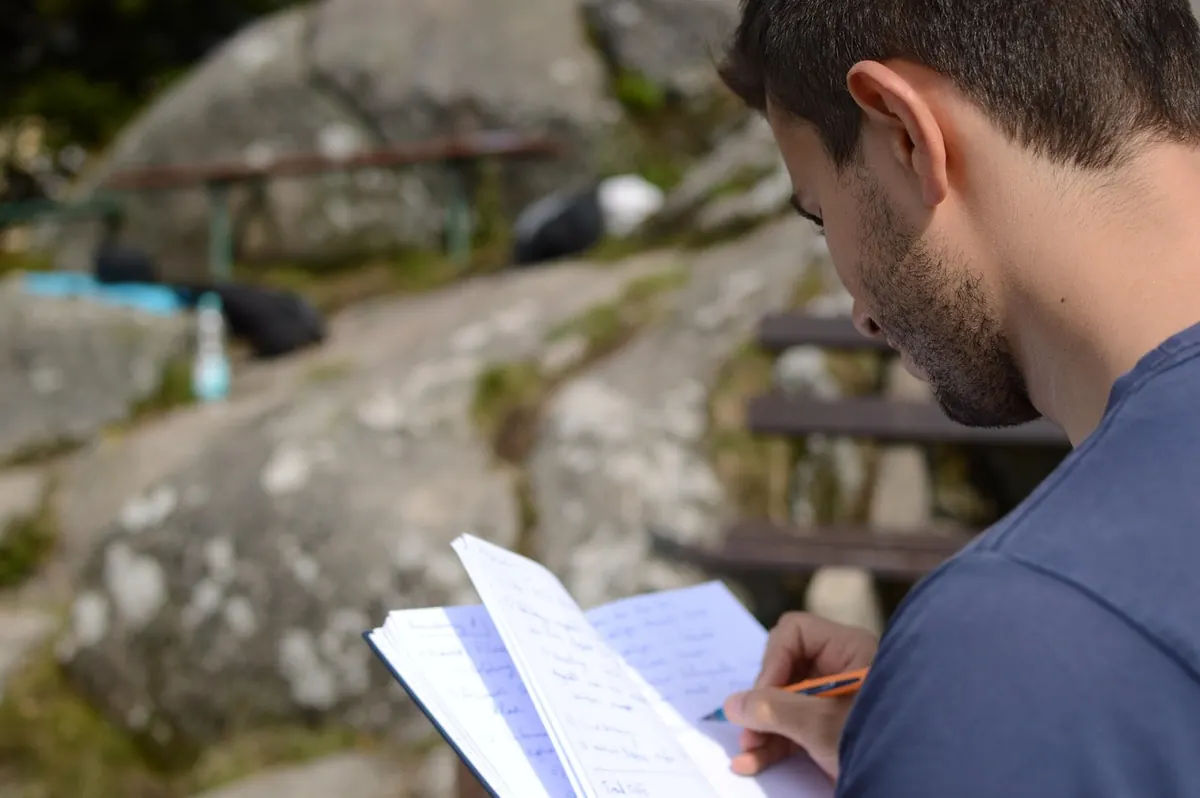
Five minutes is enough to change the tone of a day, but only if the practice is small enough to survive a bad Tuesday. A daily reflection habit does not require a leather journal, a silent house, or a perfect evening. It requires a little attention and a place to put it. You can do it at the kitchen table with a pencil stub, on the edge of the bed, or in a chair by the window before the lights go out. The goal is not to produce a record of your life. The goal is to notice it.
Reflection gets postponed because people imagine a long session: pages of journaling, a candle, a grand review of goals. That version collapses in the first week. Five minutes works because it asks for something you can repeat on an ordinary Wednesday. It creates a small pause between doing and sleeping, or between waking and checking messages. In that pause, you can register what happened, what mattered, and what you want to carry forward.
A short practice also lowers the stakes. You are less likely to perform insight or hunt for the perfect sentence. You can write three lines, sit quietly for two minutes, or answer one question. Consistency matters more than depth on any single day. Over weeks, those small check-ins build a clearer sense of how you are actually spending your attention.
The most reliable time is attached to something you already do. After you pour your morning coffee. After you close your laptop for the day. Before you brush your teeth at night. Choose one anchor and treat the reflection as part of that routine, not as an extra item floating somewhere in your schedule.
Then choose a spot. A specific chair, a corner of the kitchen table, the end of the sofa, even the bathroom with the door closed if that is the only quiet place in the house. Keep your notebook or phone there. The place does not need to be peaceful in a magazine sense. It only needs to be easy to reach.
On chaotic days, decide in advance what counts as done. Sitting down and taking three slow breaths is a complete practice. A single sentence is a complete practice. The bar should be low enough that you do not have to negotiate with yourself when you are tired.
The setup should take less time than the practice. If you need to find a pen, clear a table, and download an app, you will skip it. Keep a small kit together and leave it where you sit.
If you prefer typing, open a single document before you sit down. Use the same file every day so you are not hunting for the right place to begin.
You do not need a rigid ritual, but a simple shape helps the five minutes feel contained. Try this:
If you are writing, fragments are fine. “Tired. Good talk with Mina. Forgot to eat lunch.” That is usable. If you are sitting without writing, let the question sit and see what surfaces. The timer is a boundary, not a test.
A prompt should open a door, not create homework. Keep a short list and use one for a week rather than searching for a new question every day.
Ask: What can wait until tomorrow? Then write down one thing you are giving yourself permission to postpone.
Ask: What went better than expected? It can be tiny. A conversation that did not go badly. A task that took less time. A meal you actually enjoyed.
Ask: What am I avoiding, and what is the smallest first step? You do not have to take the step. Naming it is enough for today.
If prompts feel like a form to fill out, use one sentence stem: “Right now, I notice…” and finish it three times. That is a reflection. It does not need to become an essay.
The quickest way to kill a five-minute practice is to turn it into a measure of how well you are doing. Reflection is not a productivity system. It is a place to be honest, and honesty rarely looks impressive.
If reflection regularly leaves you agitated or brings up serious distress, stop treating it as a solo task and talk with a qualified professional. A daily habit can support clarity, but it is not a substitute for care.
For the next seven days, do only this: pick one anchor, put a notebook and pen nearby, set a timer for five minutes, answer one question, and stop. Expect two or three days to feel awkward. Expect one day to be skipped. On the day after the skip, sit down again without making it a drama.
After a week, look back only long enough to notice what kind of notes you wrote. If you wrote three words each day, keep the practice at three words. If you wanted more time, add two minutes, not twenty. The point is not to build an impressive archive. The point is to give yourself a small, repeatable place to notice what is already there. Five minutes is not a lot. That is exactly why it can last.
Photo: OrcaTec / Pixabay

Shop signs, window displays and opening hours are quiet local records. Learning to read them shows how a...

Noticing the ordinary life around you is a skill, not a talent. A practical guide to watching routines, gestures and...

A practical guide to small-town Italian market manners: when to arrive, how to greet, how to choose produce without...

Reflections and stories from narrow streets..