You find them on small ceramic plaques, often white with a dark border, screwed into a wall at the corner: Vicolo del Forno, Vicolo della Luna, Vicolo San Niccolò. The word turns up in addresses, on maps, and in the mouths of people giving directions — "take the second vicolo on the left, then straight on until the arch." It looks like an ordinary street word. It is more than that. In Italian towns the vicolo is architecture, social arrangement and a way of moving through a place all at once. Once you start noticing them, a town stops looking like a set of monuments and starts looking like somewhere people actually live.
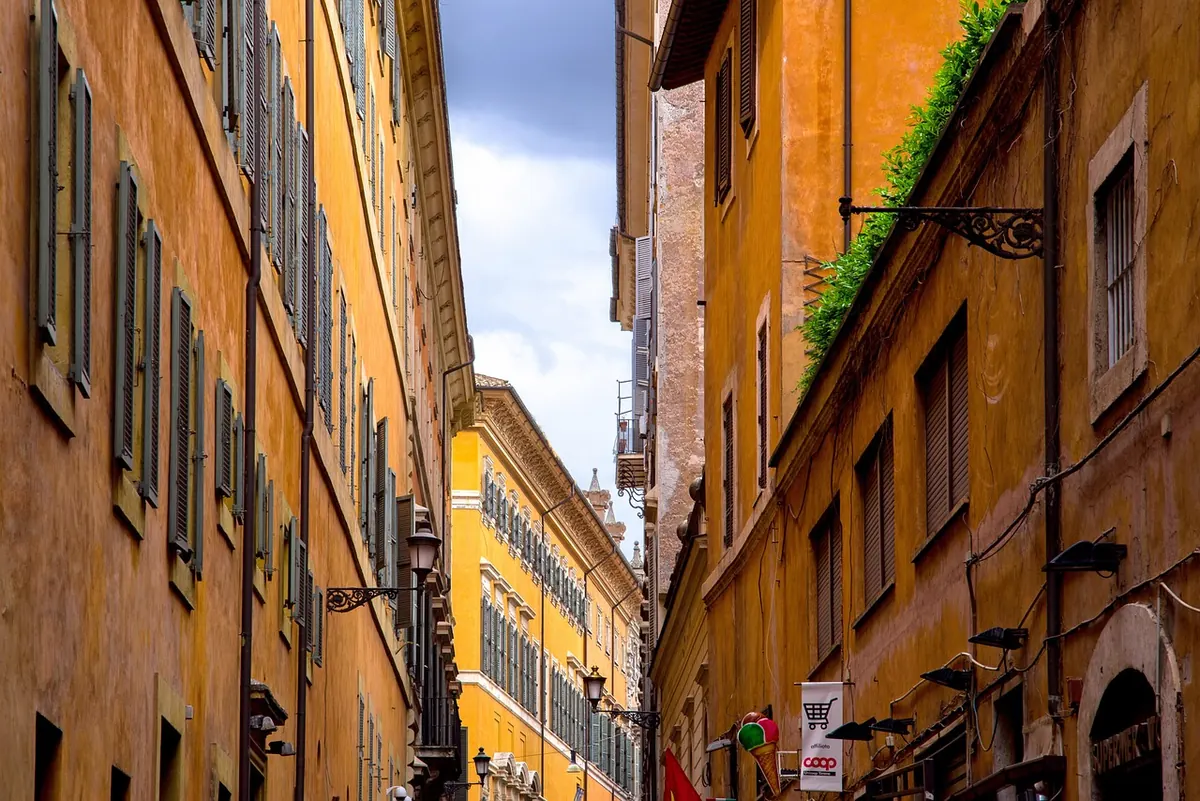
A vicolo is a narrow street: usually short, usually running between buildings, and usually without a proper pavement. Everyday Italian uses the word with a hint of intimacy and a hint of inconvenience. Nobody calls a grand avenue a vicolo. Nobody calls a busy shopping street one either. It is the lane where two people can pass comfortably, a bicycle can just about manage, and a car really should not try.
The word comes from the Latin vicus, meaning a street, a quarter, a cluster of houses — and its diminutive viculus gives us the small street. Related phrases are worth knowing. Vicolo cieco is a blind alley, a dead end. Local words vary from city to city: Venice has calli and rughe, Genoa has caruggi, Naples has vichi, Bologna has coste for its steep ones, and in parts of the north you will see chiasso. The idea is the same everywhere: a passage that belongs to the dense, old, pedestrian part of town.
Most vicoli were not designed as picturesque. They were designed as efficient. Inside the old walls, land was precious and building upwards was cheaper than building outwards, so houses grew tall and the space between them stayed tight. Upper floors sometimes lean out slightly over the street, gaining a room without taking ground. In hill towns, lanes follow the contour of the slope and turn into flights of steps without warning.
The width of a vicolo often reflects what had to get through it: a handcart, a donkey, a porter with a basket, a coffin on the way to church. That is a useful thing to remember when you are standing in one wondering how anyone ever delivered a wardrobe.
Narrowness also does real work. In a hot summer, a lane two or three metres wide between tall walls stays in shade for most of the day, and the shade is not a small comfort. In winter the same geometry keeps the ground floor dark and slow to dry. Residents know exactly which side of the street catches sun at which hour, and you will see chairs and washing lines arranged accordingly.
In many Italian towns, front doors open directly onto the lane. There is no garden, no path, no buffer of hedge and gravel. That single fact shapes everything. The vicolo becomes the shared part of the house: the place where children play, where neighbours talk, where the dog sleeps in the afternoon, where basil and geraniums sit in pots on the sill.
Sound behaves strangely in a lane. Voices carry up and down it with almost no loss, so a conversation held at a third-floor window can be followed clearly from the pavement. This is charming when it is a grandmother calling someone in for lunch and less charming at midnight. If you are staying in a rented room in a historic centre, assume the lane hears everything and that the walls are thinner than they look.
There is a rhythm too. A vicolo can be empty at eleven in the morning and full at eight in the evening, when chairs come out, the bar on the corner fills up, and the whole street briefly becomes a sitting room. The lanes that feel most alive are rarely the ones on the postcard route. They are the ones with a bakery, a hairdresser, a tobacconist and a couple of doors that have not been repainted in twenty years.
Street names in Italian historic centres do not always behave. A lane can change name at a corner, so the plaque matters more than the map. Numbering often follows its own local logic rather than a simple odd-and-even pattern, and a door may have no number at all while the shop next to it has two. If you are looking for an address, check both ends of the vicolo and look above the doorway rather than at eye level.
Watch for the words on the sign. Vicolo cieco means the lane ends; useful to know before you commit with luggage. A lane that appears to pass under a building is usually public, even if it feels like someone's hallway. A gate, however, means a gate. Private courtyards and stairways are common, and a lane that narrows to a doorway with a bell is a good sign you have reached the edge of what is yours to walk.
Vicolo cieco is also the phrase Italians use for a situation with no way out, and the physical experience explains why. You walk in, the light changes, the walls close, and you arrive at a wall, a gate, or a small courtyard with a lemon tree. Then you turn around.
Nothing is wasted. You have seen the back of a building, a scrap of garden, a cat asleep on a step, a faded sign for a workshop that closed decades ago. Getting slightly lost in a vicolo is one of the more reliable ways to learn a town, because the lane forces attention. There is nothing to look at except what is close.
Pick one lane off the main route and walk it twice: once in the morning, once after dark. Buy something small from a shop inside it — a coffee, a piece of fruit, a stamp — and you will have a reason to come back. Write the name down; the plaque is the easiest thing to forget and the nicest thing to find again on a return visit. Carry water in summer, mind the steps when it rains, and treat closed doors as closed. The rest you can learn by walking slowly.
Photo: djedj / Pixabay
Shop signs, window displays and opening hours are quiet local records. Learning to read them shows how a...
Noticing the ordinary life around you is a skill, not a talent. A practical guide to watching routines, gestures and...
A practical guide to small-town Italian market manners: when to arrive, how to greet, how to choose produce without...

Reflections and stories from narrow streets..